Building a Vow-Bound Heroine
I write mouthy heroines. Honestly, I write them because I’m a mouthy woman whose mouth often gets herself in trouble, so in my dark fantasy short tale collection, Saint of the Shattered Veil, I set about to try something different: a hero for whom silence was a central concept.
In this blog post, I break down how I built the Veiled Rose—a vow‑bound holy warrior protagonist in my dark fantasy collection, Saint of the Shattered Veil. We’ll talk about her three vows, how they shaped every scene, and how to use constraints to write sharper, more emotionally intense characters.
That being said, imagine me trying to write a main character who:
almost never speaks,
never shows her face in public,
and is literally not allowed to say no when someone begs for help.
That’s the Veiled Rose, the vow‑bound holy warrior at the heart of my dark fantasy collection, Saint of the Shattered Veil. Today I want to break down how I built her, how her vows became story engines instead of limitations, and how you can use similar constraints to make your own characters feel sharper and more alive.
Who is The Veiled Rose?
Anya Petrova—better known as the Veiled Rose—is a holy warrior from a contemplative order called the Veiled Sisters. She’s a survivor of a civil war, having seen her home city of Atheria burned to the ground; her family betrayed, brutalized, and murdered; and her face burned and scarred beyond easy recognition.
The Sisters took her in, trained her, and gave her a new identity and purpose behind burnished iron and lace: a veiled, vow‑bound defender who wanders the country and the lands beyond answering calls for aid, slaying monsters, and dealing with the fallout from old pacts and merciless bargains.
On the surface, she looks like a classic dark‑fantasy knight: armor, longsword, spiked mace, grim determination.
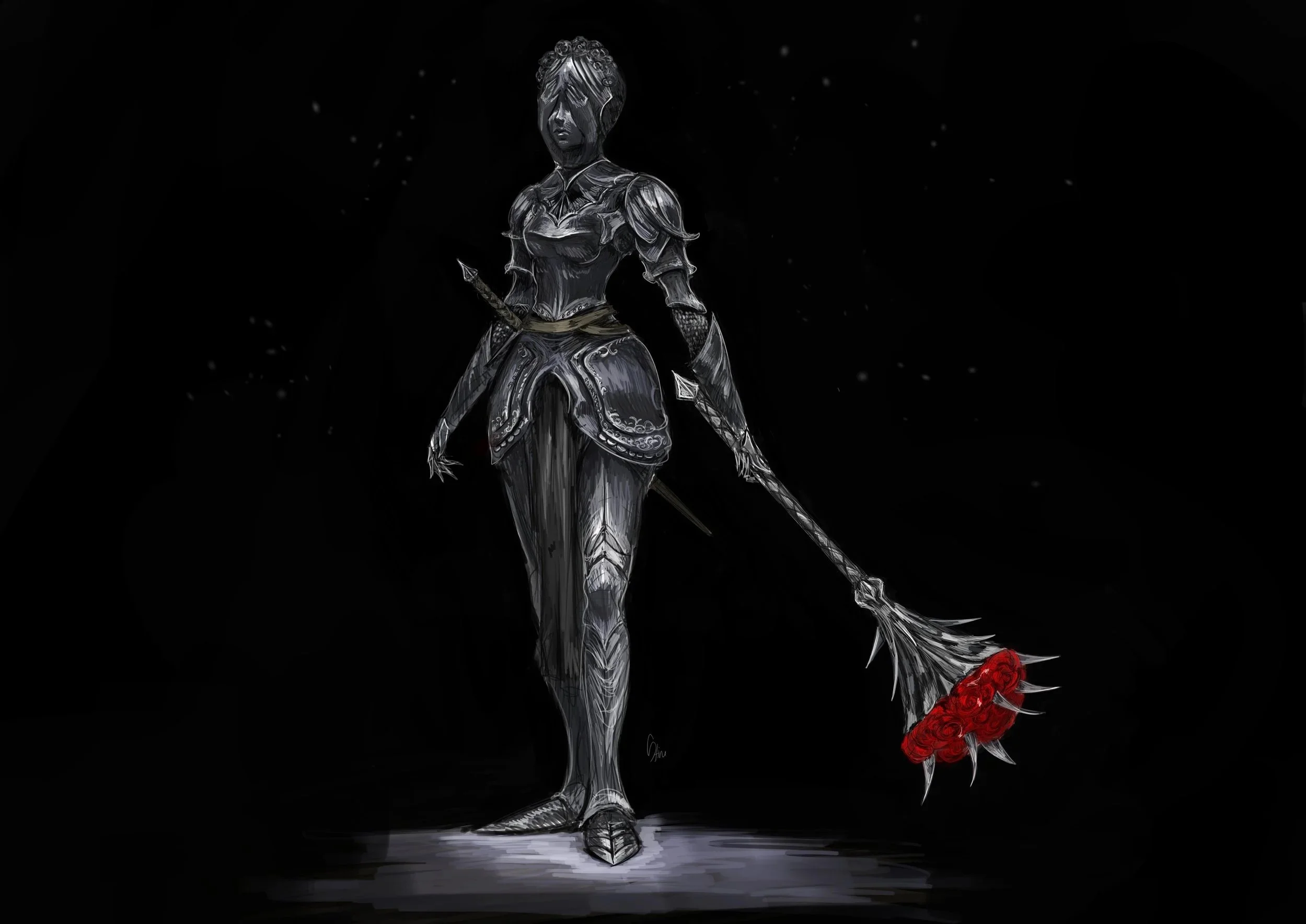
The Veiled Rose, by Stine K. Hansen
But structurally, she’s built around three very specific vows that control how she moves through every scene.
The three vows are:
The Vow of Necessary Speech.
The Vow of Veiled Visage.
The Vow of Charitable Aid.
Each one is a constraint I slapped on myself—and I really think those restraints jumpstarted my creativity and explain why she works.
The Vow of Necessary Speech
The first vow is the Vow of Necessary Speech. In short: she only speaks when it is truly necessary and uses as few words as possible to convey her meaning. Not just ‘I’m introverted’—this is a religious discipline. Every word is weighed.
In practice, this means:
She rarely explains herself.
Other people fill the silence, project onto her, or underestimate her.
When she does talk, those lines carry weight.
The purpose of this was to challenge myself to get away from the mouthy, sarcastic heroines I tend to write, heroines who quip and snark and banter on every page. I wanted to give the impression of silence as discipline, both for Anya and for myself.
And then, if everyone knows her vows, when she chooses to speak at length, it carries rhetorical meaning.
As a writer, this vow forced me to:
Cut a lot of dialogue I would have given a more talkative protagonist like Samantha Hain.
Rely on body language, gesture, and other characters’ reactions.
Let implication do more work than exposition.
It also creates tension. In social or political scenes, people keep trying to drag more words out of her. They get uncomfortable. They project holiness, menace, or coldness onto her, depending on what they need.
Veiled Visage
The second vow is the Vow of Veiled Visage. She must remain veiled—face covered—whenever she’s outside the most private, trusted spaces. In armor, that’s a helm shaped to resemble a woman’s face with golden hands covering the eyes as she cries. Out of armor, it’s a circlet and lace veil.
This started as a religious symbol, but for Anya it becomes something else. Because of her scars and what she lived through in the war, the veil is both shield and prison.
Strangers see a myth: the Veiled Rose, holy avenger, an unstoppable bulwark against darkness.
Enemies see an obstacle: a faceless weapon of a church.
Lovers and close friends see the person underneath—but that’s rare and deliberate.
In one story, there’s a dinner scene with her Moon‑Elf sorceress lover, Seraphine, where she finally removes both helm and veil in a private townhouse. For Seraphine, it’s not the first time she’s seen Anya’s face; but for the reader, it is. And it’s a tectonic shift.
Suddenly, all that devotional language about veiling and the sacred becomes intimate. The acceptance of who Anya is and what she has suffered is met with acceptance and love, and so removing the veil becomes a moment of identification and connection. The reader realizes how much vulnerability is wrapped up in the simple act of being seen.
From a writing standpoint, the veil did a few things:
It made me handle description differently. I couldn’t lean on facial expression as a crutch. I had to show emotion in stance, in the way she grips her mace, in how long she pauses before answering.
It turned the act of unveiling into a story beat. If she takes off the helm or lifts the veil, that’s never casual. It’s a character choice that means something in the relationship or the plot.
Charitable Aid
The third vow is the Vow of Charitable Aid, and it’s the sharpest one: She may not refuse a request for aid. If someone reaches out to the Veiled Sisters—and later, to her specifically—begging for help against monsters, curses, or injustice, she is obligated to answer, as long as it’s within her power.
This vow is the engine that pulls her into almost every story in the collection:
A terrified grave priest in the ruins of Atheria sends a note about gnawed bones and sickly green light in the catacombs. She’s exhausted from fighting a basilisk, but she goes anyway.
A lord whose family land is haunted by an undefined monstrosity begs her to come, not telling her it’s tied to his bloodline’s dark pact. She goes.
Villagers whisper about the cursed ship that won’t let the dead rest; she gets dragged into that too.
From a structural perspective, this vow is what lets the collection function like an episodic ‘monster‑of‑the‑week’ series with a single throughline character. I don’t need contrived reasons to move her from city to city; the vow is the reason.
But it’s also a source of pressure.
She can’t opt out, even when she knows she needs time to heal.
She can’t ignore people who might be lying or omitting crucial details.
Every plea for help becomes a moral question: is this really aid… or am I being used?
There are moments where she wants to say no. She hesitates. She considers the cost. And then the vow wins.
Those are the scenes where her faith and trauma collide. And that conflict drives so many decisions…
Taken together, these vows sit on top of a pretty bleak backstory.
As a child, Anya watched her city betrayed and burned during a civil war. Her father, a knight of a holy order, was executed. Her family was brutalized and killed. She survived by her mother’s love, by chance, and by the intervention of a woman who brought her to the Convent of the Flaming Veil.
The vows start as survival:
Silence protects you from saying the wrong thing.
A veil protects you from people’s stares and cruelty.
Service gives shape to grief.
But over the course of the collection, the world that made those vows necessary changes. The institutions fail her.
What she chooses to keep—what she personally re‑commits to—becomes the point.
Does she still believe in Elysia’s light? Enough to sacrifice her last physical tie to her family in an eldritch basilica rather than take easier power offered by something older and hungrier?
Does she keep her vows when love, or a vampire duchess, or a desperate city offers alternatives?
For the Veiled Rose, those vows make her hard to write sometimes—but they also make her unmistakably her.
If you’d like to see how all of this plays out on the page—with mausoleum monsters, haunted catacombs, cursed ships, masked courts, and a very stubborn Moon‑Elf sorceress girlfriend—Saint of the Shattered Veil is my dark fantasy short story collection about her.
Available 21 April.
